Wednesday, 9 November 2011

Sound Design Project

The scene is, "Scene 04, 3D Movie". The main character, Jacob, (played by Steven Stagg), walks into his lounge room and watches a 3D movie with his housemate (played by Steven's real-life housemate Eric). During the movie 2D animated characters come out from their hiding spots and start chasing him. He takes the glasses off to try and stop seeing them, but on his way another character sprays him in the face with a watered down spray of the "Invisypaint".

Backstory for this scene:
Jacob stumbles across paint that can turn people invisible in our dimension, but 2D in another co-existing dimension.  A person who paints themselves with this "Invisypaint" becomes a 2-Dimensional animated character. The paint allows the wearer to see an entire 2D world that co-exists with our own. The 2D world, though invisible to us, can fully interact with our world and everything in it. 
Unbeknownst to Jacob, the 2D thugs he's been running from, (they don't like that he's seen their world), have painted the pair of 3D glasses he puts on. When he puts on the glasses, after a few minutes, he begins to see the 2D characters everywhere.  Some tap on the TV screen from the inside, and then climb through; some are standing in the shoes on the shoe-rack; some are hiding behind lamps, in picture frames; and others are in plain sight and start munching on things.

It seems that I cannot embed the video at this stage, but you can click HERE to see the video.

Sunday, 30 October 2011

Comparison

In a way I find it very difficult to compare these two masters of sound design, because they are two of the best in their field.  

photo link
Jimmy MacDonald comes from a time when they had to make all their sounds in house, as their sound recording equipment was far too large to take to the original sources of the sounds they needed.  On location sound recording was most often, simply out of the question.

photo link
Ben Burtt, on the other hand, started his career in a time when the equipment had become smaller and location sound recording was not only available, but also more desirable.  He did, however, look for inspiration from Jimmy MacDonald when coming up with new and "futuristic" sounds like the light saber in Star Wars.  It amazes me that he turned to the past for sounds of the future!  Definitely a smart move (which is obvious when you look at his success!) and one I'll be keeping in mind!

In conclusion, both of these men are masters when it comes to the topic of sound design, and I -as many, many others- will continue to look to them as inspiration for years to come.

Jimmy MacDonald

As part of this blog I have to compare my first chosen designer with a second.
The first designer I've spoken about is Ben Burtt and his amazing sound design.

The second designer I'd like to talk about is Jimmy MacDonald.  


photo from http://www.dvdizzy.com/images/t-v/tlav1-13.jpg
MacDonald was a sound designer for Disney, and was appointed head of the sound effects department by Walt Disney himself!
He is very much the father of sound effects, and Ben Burtt has said he was inspired by Jimmy MacDonald.

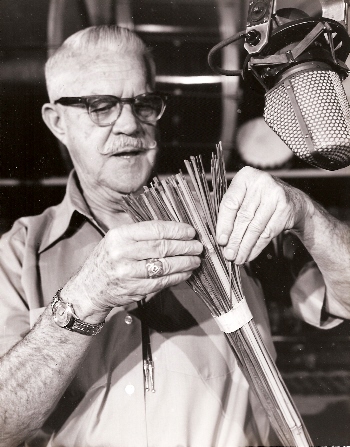
photo from http://www.michaelbarrier.com/Funnyworld/Macdonald/Macdonald0001.jpg

Jimmy MacDonald started as a drummer (as did most sound effects designers back then I was  surprised to find out!) and in the 1930's he played with a band on the "Dollar Steamship Line".  

When he first began working for Walt Disney, MacDonald said:

"You know I had an awful time being still about the idea of not getting ready to go on a boat or whatever, ah, it was certain, certain sound of that foghorn and so-forth that it was tough to settle down."

In the end though, he decided that the foghorn couldn't compare to making sound effects for Mickey Mouse cartoons with Disney:

"I used to drive by it….and they had a great huge sign out in front with big pic, er, a big picture of Mickey. And ah, I'll never forget my first day coming over, I was, scared outta my wits, I really was, I thought, 'ooh, big studio, Disney Studio'. Because, we were all raised on Mickey Mouse." 

Early Mickey Mouse cartoons used musical sounds for their sound effects.
MacDonald created the sound props department at Disney:
"They had no props, not one prop here, that's why drummers were called. First place they had the facility in their hands, to do, everything that was required. And it was mostly the ah, the props that pit drummers would have, the slide whistle, the dude harp, the break drums,  ah, bulb horns, all of those gadgets these drummers had. The studio didn't have any. So after a couple of calls, I was asked, if I'd liked to stay and help develop a sound effects department, and I thought that was great!"

Jimmy MacDonald found himself working on many projects at the same time and didn't always know the names of the films he was working on:

"I worked on many pictures and never even knew the name of the things. I'd be down there doing the effects and ah, the name really wasn't as important to me as it was [to] the animators."

MacDonald made many, many sound effect props in his time at Disney.  These props made all sorts of sounds, from a creaky screen door spring (as I noted was commented on by Ben Burtt in my last blog entry) to machine gun sounds, rain, wind, and wave machines. 
One of these props in particular that was talked about in the video, is the rain machine.
It's an enclosed cylinder (like the raffle barrels that spin with a handle on the side) and it has strips of nails attached on the inside, with the points sticking out, and dried peas that move freely.  When the barrel is turned, the peas run over the nails making a sound like rain falling.  And you can spin the barrel faster or slower depending on how you want the rain to sound.  I personally found this one of the most interesting of the props, because it seems so simple, and yet it's an incredibly effective sound machine!  I would love to try it out myself!

Thursday, 18 August 2011

The Designer I've Chosen

I decided the sound designer I'll be researching is Ben Burtt because I love his work!


Ben Burtt (pictured above with his good friends WALL-E and EVE, photograph from http://www.listal.com/viewimage/1318248)  is an amazing designer and described by many as a "sound legend".


He is responsible for the famous sounds of lightsabers, Darth Vader's breathing and the voice of R2D2 in the Star Wars movies.
And he is also responsible for the sounds of the film about the loveable Disney-Pixar robot Wall-E!
Link to original photo


Burtt has also worked on other films by Lucasfilm Limited with subsidiary Skywalker Sound, (I will research these further in future blogs), and for  J.J. Abrams' Star Trek film (which I will also address again after further research!).


I've found a youtube video about Ben Burtt's work on the Wall-E film: 


WALL-E Special Features Animation Sound Design:Building Worlds From The Sound Up (Part 1)


I found this video particularly interesting and very educational in the ways of creating simulations of every day sounds using objects they can bring into the studio.  Disney has been around for a long time and it was fantastic to see them showing Burtt how things used to be done all the time by them, and to hear his comparisons of using the tools that make the simulated sounds versus physically going out and collecting the sounds from the original places as he used to do. An example of this from the film is when Burtt says to get the sound of a creeky screen door, he would travel out to a house with the kind of screen door he needed the sound from, and wait for quiet so he can record the sound of the door being opened and closed. Disney Studio's have a small box with a spring that makes the exact same sound and they keep it on a shelf in their store room. Amazingly simple! 

There's a great quote in this video from Andrew Stanton (Director of WALL-E) about sound design on  animated films, and in this case especially WALL-E: 

"The big thing that's unique about sound design on animation, is the fact that you get nothing for free. You don't get on a set, and hear the way the environment sounds naturally, or the way somebody walks across a room, or just their voice. But in this case, because there isn't dialogue that often, it puts all this emphasis on every little squeak, beep, squawk; now they all have to MEAN something, or you have to be careful if you use them, people will THINK they mean something."


Link to original photo
I've personally found that in any type of film or production (such as theatre) sound is one of THE most important aspects needed for success.  I've participated in plays myself, and in television commercials (both in front of the camera and editing behind the scenes), I've also worked on radio, been interviewed on camera and interviewed others on camera, and as a final addition to this list, I've volunteered my help in my 5 year old son's classroom, and every single one of these situations needed fantastic sound (in one way or another!) to make it successful! =D


Monday, 15 August 2011

Introduction

Hi! Welcome to my audio blog!
This blog has been created to document my investigations into the works of a sound designer, I'm yet to pick a single sound designer to investigate, but I will!
I'll have more blog entries up soon!